Something remarkable is happening in Ilé-Ifẹ̀, Osun State, this October.
The 2026 West African University Games (WAUG) are taking place at Obafemi Awolowo University (OAU), Ilé-Ifẹ̀, from 2 to 12 October 2026, bringing student-athletes, officials and university communities from across West Africa together for a major sporting gathering.
But there is something particularly interesting about this year’s Games.
While athletes will be competing for sporting honours, the host city is also putting Yoruba heritage and the cultural identity of Ilé-Ifẹ̀ firmly in the spotlight.
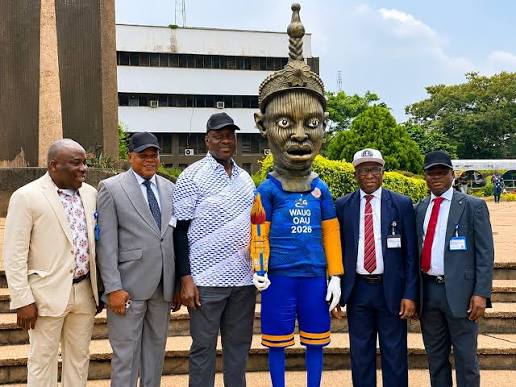
And one symbol captures that connection beautifully: Ori-Olokun, the official mascot of WAUG 2026.
Meet Ori-Olokun, the Face of WAUG 2026
The name Ori-Olokun immediately connects the Games to Yoruba cultural heritage.
According to the official WAUG organisers, the mascot was inspired by the rich heritage of Ilé-Ifẹ̀ and represents strength, wisdom, resilience and the enduring spirit of Yoruba culture.
The mascot is not simply a colourful character created to entertain spectators.
Its design deliberately incorporates elements associated with Yoruba heritage.
The official description identifies the Olokun head as a major feature, alongside an Ọ̀pẹ̀lẹ̀ divination chain and cowries. These elements were chosen to connect the modern sporting event with aspects of Yoruba cultural and spiritual heritage.
That makes Ori-Olokun particularly significant for a city like Ilé-Ifẹ̀.
Why Ilé-Ifẹ̀ Is the Perfect Cultural Setting
To understand why the mascot matters, we need to understand the place where the Games are being hosted.
Ilé-Ifẹ̀ occupies a unique position in Yoruba history and cultural memory.
The ancient city is widely regarded as an important centre of Yoruba civilisation and holds a special place in Yoruba traditions concerning origins, kingship, spirituality, art and culture.
It is therefore fitting that an international university sporting event taking place in the city should carry symbols connected to its heritage.
WAUG 2026 is consequently more than a sporting gathering for Ilé-Ifẹ̀.
It is also an opportunity for thousands of visitors to experience a city whose history extends far beyond the modern university campus.
When Sport Meets Culture
Sport has a remarkable ability to bring people together.
At WAUG 2026, students and university representatives from different West African countries are expected to gather in Ilé-Ifẹ̀ to compete, interact and build friendships.
The official WAUG platform describes the Games as bringing universities together through sport while promoting education, culture, respect and regional cooperation.
This creates an interesting cultural exchange.
A student arriving in Ilé-Ifẹ̀ primarily for athletics, football, basketball or another sporting event may also encounter Yoruba food, language, music, clothing, art, history and traditions.
In that sense, sport becomes another doorway into culture.
What Does “Ori” Mean?
The word “Orí” is one of the most important concepts in Yoruba thought.
Literally, orí means head, but within Yoruba philosophical and spiritual traditions, the concept can carry much deeper meanings relating to one’s inner essence, destiny and personal spiritual identity.
This makes the name Ori-Olokun particularly interesting within the cultural setting of Ilé-Ifẹ̀.
The organisers’ choice of the name and symbolism allows the mascot to connect a contemporary sporting event with ideas and symbols rooted in Yoruba heritage.
Who Is Olokun in Yoruba Tradition?
Olokun is an important Òrìṣà associated in Yoruba traditions with the sea and is also connected with wealth, prosperity and abundance.
The official WAUG description specifically identifies the Olokun head as a symbol of wealth, prosperity and the sea in Yoruba mythology.
Using Olokun imagery for a major West African sporting event hosted in Ilé-Ifẹ̀ therefore gives the mascot a strong cultural identity.
It also demonstrates how traditional symbols can be reinterpreted in modern settings without losing their connection to heritage.
The Ọ̀pẹ̀lẹ̀ and the Story of Knowledge
Another striking element of the mascot is the Ọ̀pẹ̀lẹ̀, a divination chain associated with the Ifá tradition.
Ifá is one of the most important bodies of indigenous Yoruba knowledge and has been transmitted through generations by trained practitioners.
The inclusion of the Ọ̀pẹ̀lẹ̀ connects the mascot to ideas of knowledge, wisdom and traditional Yoruba intellectual heritage.
This is particularly appropriate for a university competition.
Universities are places where knowledge is pursued, preserved and transmitted, while the Ọ̀pẹ̀lẹ̀ represents an entirely different but historically significant indigenous system of knowledge.
The symbolism creates an interesting bridge between ancient Yoruba knowledge and modern academic life.
Cowries: More Than Decoration
The mascot also incorporates cowries, which have a long history in West African societies.
Cowries have been used historically as currency and have also carried social, cultural and symbolic significance.
The WAUG organisers describe the cowries as part of the mascot’s cultural symbolism, including associations with prestige and shared identity.
Once again, a traditional object has been transformed into part of a modern symbol.
A West African Gathering in the Heart of Yorùbáland
WAUG 2026 is expected to bring universities and student-athletes from countries across West Africa to Ilé-Ifẹ̀.
The official Games platform lists participating countries including Nigeria, Ghana, Senegal, Côte d’Ivoire, Benin, Togo, Sierra Leone, Liberia, The Gambia, Guinea, Guinea-Bissau, Mali, Niger, Burkina Faso, Mauritania and Cabo Verde.
Imagine the cultural exchange.
Young people from different parts of West Africa arriving in an ancient Yoruba city, competing on the same sporting fields and sharing experiences with one another.
That is one of the most beautiful possibilities created by the Games.
Obafemi Awolowo University Takes Centre Stage
The host institution is Obafemi Awolowo University, one of Nigeria’s prominent universities.
The university is preparing sporting facilities, accommodation, transportation, security, medical services, accreditation and volunteer coordination ahead of the Games.
The university’s location adds another layer to the event.
OAU is not simply hosting WAUG in an ordinary city.
It is hosting it in Ilé-Ifẹ̀, a place deeply associated with Yoruba civilisation.
That gives the university an opportunity to welcome visitors while showcasing the cultural environment surrounding the campus.
A New Generation Seeing Yoruba Culture
Perhaps the most exciting part of WAUG 2026 is what younger people can take away from it.
Many young Africans are increasingly interested in reconnecting with indigenous identity, language, history and culture.
Seeing Yoruba symbols incorporated into an international sporting event sends an important message:
Yoruba heritage belongs not only in history books and museums. It can also exist confidently in modern life.
A Yoruba symbol can appear on a university mascot.
A traditional concept can inspire contemporary design.
A centuries-old city can host a modern international sporting competition.
And culture can become part of the experience without preventing modernity.
From Ancient Ilé-Ifẹ̀ to Modern WAUG
This is perhaps the most fascinating story behind WAUG 2026.
On one side is ancient Ilé-Ifẹ̀, with its traditions, sacred histories, art, kingship and cultural memory.
On the other is a modern university hosting athletes from across West Africa.
Between the two stands Ori-Olokun.
A mascot.
A sporting symbol.
And, according to its creators, an expression of the strength, wisdom, resilience and enduring spirit of Yoruba culture.
Why This Matters to Ilẹ̀ Abínibí
At Ilẹ̀ Abínibí, we believe that culture should not simply be remembered.
It should be understood, documented, celebrated and passed on.
WAUG 2026 provides a beautiful example of how Yoruba heritage can remain relevant in contemporary society.
The Games bring together sport, education, youth, international friendship and culture.
And Ilé-Ifẹ̀ provides the setting.
Did You Know?
WAUG 2026 is taking place in Ilé-Ifẹ̀ from 2 to 12 October 2026, and its official mascot, Ori-Olokun, was inspired by the rich Yoruba heritage of the ancient city.
So when you see the athletes competing this October, remember that there is another story unfolding around them.
Ile-Ifẹ̀ is not only hosting the Games. It is sharing a piece of Yoruba heritage with West Africa.
What Do You Think?
If you could introduce a visitor coming to WAUG 2026 to one aspect of Yoruba culture, what would you choose?
Yoruba language, Ifá, traditional food, music, clothing, art, history, festivals or the story of Ilé-Ifẹ̀?
Tell us in the comments.
Ilẹ̀ Abínibí — Preserving the Story, Celebrating the Heritage. 🌿