

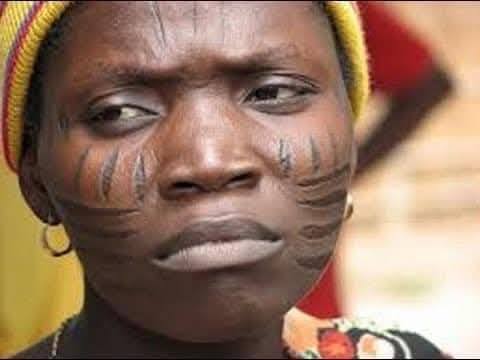
Abínibí tribal marks are cut lines on the cheeks or beside the mouth, once used to show family, town and identity. They are part of a practice that has faded sharply, and today it is discussed as both heritage and harm. This explainer draws on a Guardian Nigeria feature that appeared in today’s Google Alerts digest, a review article in the Nigerian Journal of Dermatology, and a feature on the tradition’s decline.
The main marks and where they came from
Different towns and families had their own patterns, and a person’s marks could show where they came from. The Guardian article names several Abínibí styles and links some of them to places. The table below sets out the marks described in the sources.
| Mark | Linked to | What it looks like |
|---|---|---|
| Pele | Ile-Ife, Ijebu and Ijesha variants | Three long vertical lines on each cheek |
| Owu | People of Abeokuta, Ogun State | Twelve marks, six on each cheek |
| Gombo or Keke | People of Ogbomoso and wider Oyo State | Straight and curved lines at the side of the mouth |
| Ila abiku | Children, given to prevent early death | Marks given in childhood for protection, according to Humanglemedia |
The Guardian also names Agbaja, Ture, Mande, Bamu and Jamgbadi, but gives no details for those styles. Readers should treat them as names in the record, not as described patterns.
Why the marks mattered
The sources give several reasons. The first is identity. The Guardian says the marks identified a person’s family and region, and that different families had distinct patterns. One family head interviewed by Humanglemedia, Mustapha Oloola of the Oloola-Oke household in Oyo State, said: “The identity of our people could be known from Gombo or Keke styles.”
The second is beauty and honour. The Guardian describes the marks as signs of beauty, heritage and status. The Humanglemedia article notes that Gombo styles were linked to royalty in one family it spoke to.
The third is protection and health. The Nigerian Journal of Dermatology review, by Grace Alo, lists identification, beautification and inoculation against childhood diseases among the marks’ purposes. Humanglemedia adds that incisions were once used to treat convulsions, pneumonia and measles. The review gives no evidence for those medical claims, so readers should treat them as the reported beliefs of the families concerned.
The fourth is records of lineage. The Guardian reports that in some Oyo State places every firstborn child received marks to show legitimate birth.
Why the practice is fading
Most sources agree the practice is declining. The Guardian reports that most parents now disapprove, and that some people with marks cover them with makeup or report being rejected because of them. Humanglemedia describes ridicule and shame, especially at school, as a major reason.
Health is the second reason. Dr O.O. Abiola, a health practitioner and consultant at Bowen University Teaching Hospital, is quoted as saying: “The act of making any incision should be made with sterilised equipment.” Dr Isaac Bot, a medical practitioner at Vom Christian Hospital in Jos, says any surgical problem should go to a standard hospital to avoid excessive bleeding. The review article names HIV, hepatitis B and C and other infections as risks from unsterilised tools.
The law is the third reason. Humanglemedia reports that the Child Rights Act, adopted by southern states, bans tattooing or skin-marking children, with penalties of a fine, up to one month in prison, or both. Anyone considering marks for a child should check the law in their state first.
Voices from the families
Not every family sees the change as loss. Iya Bisi, a vendor in Taki, Oyo State, who has large marks, has made sure her grandchildren do not have them. She says: “The years of shame are gone.” Her view shows that many people who carry marks now see them as part of a past they no longer want for the next generation.
The Oloola-Oke family says it still makes occasional incisions for women, and circumcisions for men, a practice it describes in its own terms. Because the practice involves cutting people, the health advice above applies to any family that still does it.
The tradition is not only Abínibí
The Guardian notes that facial marks were also practised by parts of the Hausa, Benin and Fulani peoples, with their own names for the marks. Benin called them iwu, and Hausa marks had names such as zube and doddori. The Igbo, the article says, do not have tribal marks as a cultural practice, though some Igbo people made facial incisions to protect against Ogbanje, a child believed to be repeatedly reborn and to die young.
Frequently asked questions
Are tribal marks still made today? Some families still make them, but the sources agree the practice is fading, with stigma, health risks and the law all cited as reasons.
Are tribal marks safe? The medical sources say no when done with unsterilised tools. Any surgical problem should go to a hospital.
Do people with marks face discrimination? The Guardian and Humanglemedia both report ridicule, shame and rejection, especially for children at school.
For background on the wider culture, see the Learn Abínibí pages. If you have a family account or a correction to add, you can contact the Ilẹ̀ Abínibí team.


